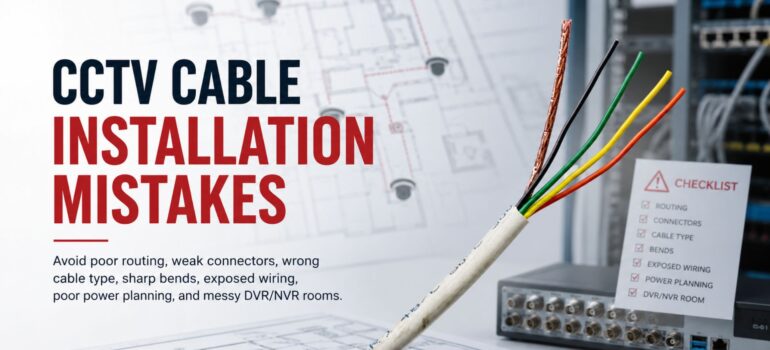
Cctv Cable Installation Mistakes is an important topic for contractors, IT companies, security integrators, builders, MEP teams and industrial buyers in Pakistan. CCTV Cable Installation Mistakes explains the practical factors that affect cable selection, price, project coordination, installation and long-term performance.
Cable should not be selected only by price, colour or a generic product name. The application, conductor, size or category, route length, environment, quantity, packaging and delivery requirements must be reviewed together. Hi-Energy Cables supports buyers with application-focused cable guidance.
Key Takeaways
- Start with the approved system or project requirement.
- Compare identical technical specifications.
- Confirm quantity, supplied length and delivery phases.
- Inspect packaging and product condition at delivery.
- Retain cable schedules, labels and test records.
Installation Quality
CCTV cable failures often begin with poor routing, tight bends, damaged sheaths, incorrect connectors, weak crimps or missing tests.
Project teams should define the intended equipment, route, environment and performance requirement before procurement. A cable that looks similar externally may use a different conductor, pair arrangement, insulation, shielding or sheath, which can change performance and installation suitability.
Selection and Supplier Comparison Table
| Review Area | What to Confirm | Why It Matters |
|---|---|---|
| Application | Power, CCTV, network, fire alarm or industrial use | Determines cable type |
| Specification | Conductor, size, category, insulation and shielding | Ensures technical suitability |
| Quantity | Total length, boxes, coils or drums | Supports fair pricing |
| Route | Indoor, outdoor, tray, conduit or underground | Determines protection |
| Delivery | Single or phased supply | Supports project schedule |
| Documentation | Labels, invoice, schedule and test records | Supports traceability |
Core Cable Selection Factors
Selection begins with the application, equipment, electrical or data requirement, route length and installation environment. Communication projects should confirm category, conductor and shielding, while electrical projects should confirm conductor size, cores, insulation and armouring.
Distance affects both signal and power delivery. Long communication routes may require active equipment, fibre or local power, while long electrical routes require voltage-drop checks and may need a larger conductor.
Comparing Suppliers Fairly
Quotations should be compared using identical technical descriptions, quantities and supplied lengths. A lower price may reflect a different conductor, shorter length, weaker construction or different packaging.
Technical suitability should be confirmed before commercial comparison. Buyers should also review lead time, delivery sequence, labels, documentation and the supplier’s ability to support project-specific requirements.
Project Documentation and Cable Schedules
Every cable requirement should be recorded in an approved schedule showing item description, destination, quantity, unit length and delivery phase. For communication projects, include category, conductor and shielding. For electrical projects, include conductor size, cores, insulation and armour.
Changes in route, load or equipment should be reflected before additional cable is ordered. Accurate schedules reduce duplicate orders, missing quantities and site confusion.
Packaging, Delivery and Site Acceptance
Cable should arrive with clear identification and suitable packaging. At delivery, buyers should inspect quantity, product identity, sheath condition, cable ends and documentation before material is moved into storage.
Original labels should remain intact until material is issued to the correct project area. Any mismatch should be resolved before installation or stock entry.
Installation, Testing and Handover
Cables should be stored safely and installed without crushing, excessive bending or uncontrolled pulling. Suitable connectors, lugs, glands and tools should match the cable type.
Testing and labels should be completed before handover. Communication routes may need continuity, wire-map or category testing, while electrical routes may require continuity, insulation and phase checks according to project requirements.
Long-Term Reliability and Total Cost
The lowest purchase rate does not always create the lowest project cost. Poor selection can cause signal loss, overheating, failed inspections, repeated service visits or cable replacement.
Replacing cable after ceilings, walls, roads, trays or machinery are complete is expensive and disruptive. Buyers should consider installation, performance, maintenance and service life.
Common Procurement and Installation Mistakes
- Requesting prices without a clear specification.
- Comparing different conductor types or supplied lengths.
- Ordering without checking route and environment.
- Ignoring phased delivery and site storage limits.
- Removing labels before material is issued.
- Using incompatible accessories or connectors.
- Skipping inspection, testing and documentation.
Buyer and Contractor Checklist
- Confirm the system, application and approved specification.
- Measure route length and calculate quantities.
- Check conductor, category, insulation, shielding and sheath.
- Compare quotations using identical descriptions and lengths.
- Plan packaging, phased delivery, storage and site inspection.
- Retain invoices, schedules, labels and testing records.
How Hi-Energy Cables Supports Project Buyers
Hi-Energy Cables supports contractors, builders, MEP teams, security integrators, factories and dealers with practical cable guidance. Buyers should share cable type, size, category, quantity, route, delivery city and timeline before requesting a quotation.
Power, electrical, solar, fire alarm and communication cable requirements can be coordinated for larger projects, helping procurement teams reduce mismatched descriptions and delivery gaps.
Technical Review Before Final Ordering
Before the purchase order is issued, the project engineer, contractor and procurement team should review the final cable schedule together. The review should confirm that each cable description matches the intended system, equipment terminals, route conditions, quantity and delivery phase. Communication routes should be checked for category, conductor type, shielding, power delivery and distance. Electrical routes should be checked for conductor size, insulation, current capacity, voltage drop and mechanical protection.
For substitutions, the proposed alternative should be evaluated against the same technical requirements rather than accepted because it has a similar name or appearance. A change in conductor, insulation, shielding, supplied length or cable construction can affect both installation and system performance.
Stock Planning and Delivery Sequencing
Large projects rarely need every cable on the same day. Builders, MEP contractors, industrial buyers and security integrators should divide demand into practical phases based on building, floor, system or installation sequence. Phased delivery reduces site congestion, lowers the risk of damage and helps procurement teams track usage more accurately.
Dealers and bulk buyers should also distinguish fast-moving stock from project-specific items. Buying large quantities without demand planning can lock cash in slow-moving products. A simple stock register showing product type, size, quantity, receipt date and project allocation improves control.
Recommended Enquiry Information
For accurate technical and commercial guidance, share the project type, intended application, cable category or size, conductor material, shielding or insulation requirement, route length, total quantity, preferred unit lengths, delivery city and expected purchase date. Clear information reduces quotation revisions and helps the supplier discuss packaging, phased delivery and product suitability more effectively.
Final technical selection should be approved by qualified project professionals before ordering, installation or energization.
Frequently Asked Questions
How should cable suppliers be compared?
Compare identical conductor, size, category, insulation, shielding, length, quantity and packaging. Then review delivery, documentation and project support.
What details are needed for a quotation?
Share cable type, application, conductor, size or category, quantity, unit lengths, delivery location and required date.
Can one cable type be used for every project system?
No. Power, fire alarm, CCTV, networking, access control and industrial circuits have different requirements.
Why does supplied length matter?
A lower box or coil price may reflect a shorter length. Buyers should compare cost using the same supplied quantity.
How should bulk cable be stored?
Keep cable dry, protected from crushing and sharp objects, with labels and cable ends intact.
Conclusion
CCTV Cable Installation Mistakes shows why cable selection and supplier comparison should be based on clear technical and commercial information. Application, specifications, quantity, delivery and documentation all affect project success.
Hi-Energy Cables supports contractors, IT teams, builders, MEP contractors, integrators and industrial buyers with practical cable guidance. Share the cable requirement, quantity, route, delivery city and timeline to discuss suitable options and request a quotation.