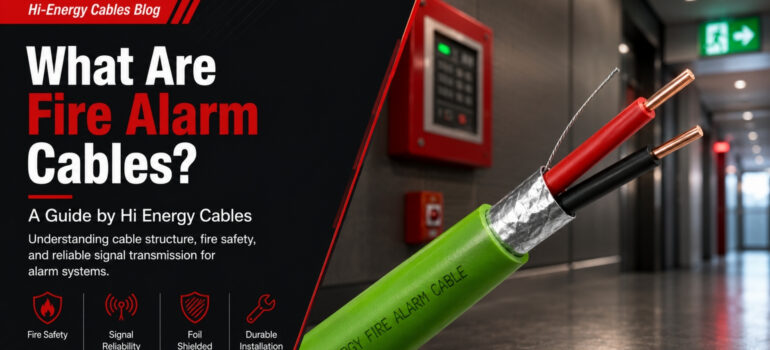
What Are Fire Alarm Cables? A Guide by Hi Energy Cables
Fire alarm cables are the dedicated wiring used to carry signals and power between fire detection devices, control panels, sounders, manual call points and other life-safety equipment. In any modern building, these cables do more than connect components; they support early warning, dependable signal transmission and coordinated emergency response. A fire alarm system can only perform well when its cable network is correctly selected, installed and maintained.
Hi-Energy Cables understands that fire safety is a serious requirement for residential towers, offices, factories, hospitals, schools, warehouses and public buildings across Pakistan. The purpose of this guide is to explain what fire alarm cables are, how they are used, what technical terms matter, and why quality should never be compromised in life-safety wiring.
What Are Fire Alarm Cables and Why Are They Important?
Fire alarm cables are specially selected low-voltage cables used in fire detection and alarm circuits. They may connect smoke detectors, heat detectors, beam detectors, manual call points, sirens, hooters, strobes, annunciators, loop modules and the main fire alarm control panel. Their main job is reliable signal transmission. When a detector senses smoke, heat or another alarm condition, the signal must reach the control panel without delay or interruption.
Unlike ordinary wiring used for lighting or basic equipment, fire alarm wiring is part of a safety system. A weak connection, poor insulation, incorrect cable type or careless routing can create false alarms, communication faults or failure during an emergency. This is why professional engineers and installers evaluate the conductor, insulation, shielding, voltage rating, current carrying capacity and installation route before approving a fire alarm cable.
Basic Construction of Fire Alarm Cables
A typical fire alarm cable may include copper conductors, PVC insulation or other suitable insulation materials, an outer sheath and, where required, a screen or shield to reduce electromagnetic interference. Copper conductor material is commonly preferred for signal circuits because it provides good conductivity, dependable termination and stable performance in low-voltage systems. In many installations, two-core or multi-core designs are used depending on the fire alarm panel and device configuration.
Conductor Quality
The conductor is the path through which the electrical signal travels. Poor conductor quality can increase resistance, reduce performance and make termination unreliable. In fire alarm applications, consistent conductor diameter and clean stranding help installers achieve firm connections at terminals, junction boxes and control panels.
Insulation and Sheath
PVC insulation and other cable insulation materials are used to separate conductors and protect them from contact, moisture and mechanical stress. The outer sheath protects the cable during pulling, routing and long-term building use. In fire alarm systems, the insulation should be compatible with the operating environment and approved project specifications.
Fire Alarm Cables in Pakistani Building Projects
Pakistan has a wide mix of construction environments, from small commercial plazas to industrial zones, hospitals, high-rise apartments and solar-powered facilities. Many buildings operate under heat, dust, voltage fluctuation and heavy electrical loads. Fire alarm systems must remain reliable in these conditions, especially where large numbers of people are present or where machinery, storage materials and electrical panels create additional risk.
Hi-Energy Cables focuses on practical cable performance for real project conditions. A fire alarm cable selected for a clean office may not be suitable for an industrial area with more mechanical stress, longer cable runs and stronger electromagnetic interference from motors or power equipment. Selection should always be based on drawings, panel requirements, cable route, local authority requirements and engineer approval.
Applications of Fire Alarm Cables
Fire alarm cables are used in many parts of a safety system. They can be installed for detector loops, notification appliance circuits, manual alarm circuits, control wiring, monitoring circuits and communication links between system modules. In a shopping mall, they may connect smoke detectors across multiple floors. In a hospital, they may support alarms in patient areas, electrical rooms and service corridors. In a factory, they may connect detection devices in production areas, stores and control rooms.
The same building may also require Power Cables for distribution boards, Electrical Cables for general circuits, Communication Cables for data and control systems and Solar Cables for rooftop or industrial solar installations. Fire alarm wiring should be planned separately from these systems while still fitting into the overall electrical infrastructure.
Important Selection Factors
Voltage Rating and System Compatibility
Every fire alarm cable should match the voltage rating and circuit design specified by the fire alarm system manufacturer and project consultant. Oversimplifying cable selection can lead to faults during commissioning. The cable should be suitable for the control panel, detector loop length, notification load and installation method.
Resistance to Interference
Fire alarm signals can be affected by electromagnetic noise when cables are routed near heavy power distribution, motors, lift equipment or industrial machinery. In such cases, screened or shielded cable may be specified to help protect signal transmission. Correct grounding and termination practice are also important.
Mechanical Protection
Some routes pass through risers, ceilings, shafts, basements or industrial areas. Where the cable may face impact, pulling stress or exposure, protection through conduit, trunking or suitable installation methods should be considered. The cable itself must also be handled carefully to avoid insulation damage.
Benefits of Choosing Quality Fire Alarm Cables
Quality fire alarm cables support stable communication between devices, reduce nuisance faults and help installers achieve cleaner commissioning results. A properly selected cable also supports easier maintenance because technicians can trace, test and terminate circuits more confidently. For building owners, this improves long-term safety and reduces the risk of repeated complaints after handover.
Hi-Energy Cables positions cable quality as a practical investment, not a decorative feature. In life-safety systems, the lowest initial price can create higher risk later if the cable causes faults, weak terminations or performance issues. Choosing a reliable cable manufacturer helps engineers protect the reputation of the project and the safety of occupants.
Industry Insight: Fire Safety Depends on Complete Systems
A fire alarm cable alone does not make a building safe. It must work with correct detectors, approved panels, professional installation, proper testing and scheduled maintenance. However, the cable is one of the hidden foundations of the system. Once ceilings close and walls are finished, replacing poor wiring becomes difficult and expensive. This is why experienced project teams make cable selection early, not at the last moment.
For a complete electrical plan, project teams should review fire alarm wiring together with related Hi-Energy Cables categories such as Electrical Cables, Power Cables, Communication Cables and Solar Cables. A building is safer when every cable category is selected for its actual duty, environment and voltage rating instead of being treated as a general-purpose item.
FAQ: Fire Alarm Cables
1. What is the main purpose of a fire alarm cable?
A fire alarm cable carries signals and low-voltage power between detection devices, alarm devices and the fire alarm control panel. Its purpose is to support reliable warning and system communication.
2. Are fire alarm cables different from normal electrical wires?
Yes. Fire alarm cables are selected for safety-system circuits, signal transmission, insulation performance and installation requirements. Normal electrical wires are not automatically suitable for fire alarm systems.
3. Which conductor is commonly used in fire alarm cables?
Copper conductor is commonly used because it provides good conductivity, stable termination and reliable performance for low-voltage fire alarm circuits.
4. Can fire alarm cables be installed near power cables?
They should be routed carefully according to project specifications and applicable codes. Separation from heavy power cables is often recommended to reduce interference and maintenance issues.
5. Why choose Hi-Energy Cables for fire alarm wiring?
Hi-Energy Cables focuses on dependable cable construction, practical project suitability and quality-focused supply for residential, commercial and industrial fire safety systems.
Conclusion
Fire alarm cables are a critical part of building safety infrastructure. They support early warning, signal transmission and dependable communication between life-safety devices. For Pakistani projects where reliability, safety and long-term performance matter, selecting the right fire alarm cable is a serious engineering decision. Hi-Energy Cables helps project teams choose quality-focused cable solutions that support safer buildings and stronger electrical infrastructure.